Villa Sedan - History

historia Villi Sedan

130 years of the Villa Sedan history

Sedan, from Latin Sedatus, means a peaceful and quiet place. Sedan is also name of the town in Northern France where on the 1st of September 1870 German troops, under the command of Field Marshal Helmut von Moltke, forced the 83.000 army of Napoleon III to surrender and thus determined the outcome of the Franco-Prussian War.


The first construction

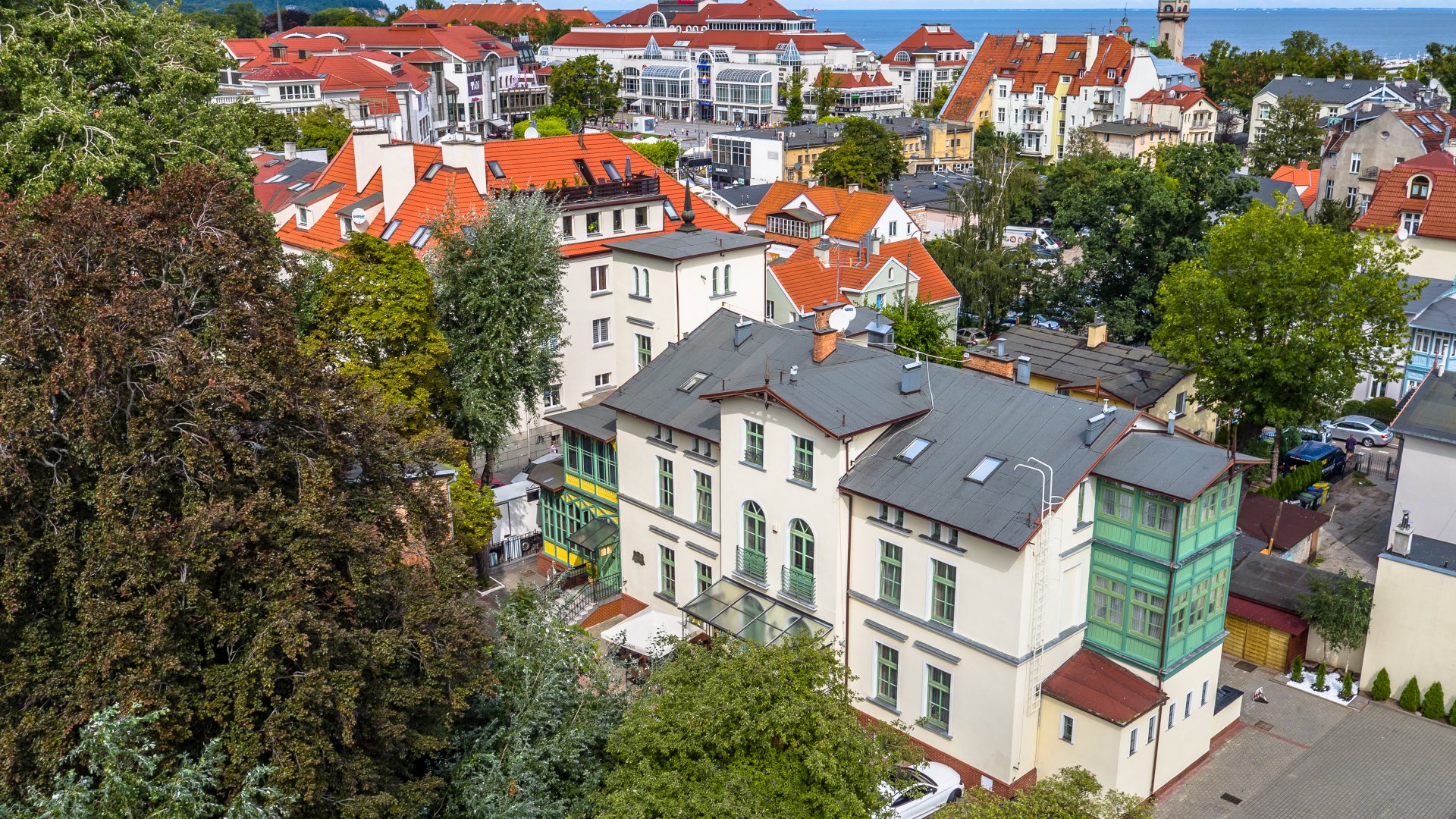
The name of the guesthouse opened a few years later at Chancellor Otto Bismarck (the person who insidiously initiated the conflict) street, made a reference to the events at Sedan. On the turn of the 19th century a street at the guesthouse was named Helmut von Moltke, and the street linking the house with the spa's main avenue was called Sedanese. Today the previous Sedanese street has General Joseph Bem as its patron and Moltke street - General Stanislaw Fiszer. The guesthouse itself is situated at today's General Kazimierz Pulaski street.

As old real estate registers of the Sopot's court say a Gdansk rentier, Adolph von Loewen, purchased a 1600 sq.m. parcel situated on the southern side of Bismarck street for 400 Marks in December 1874. Then, it was just a non-built-up area. In May the following year he took a mortgage and began to build. It is exactly when the present house was erected.

Two years later, on the 26th of April 1877, another rentier, Ferdinand Vruum, bought a built-up parcel from Loewen's widow for 15.100 Marks. Just after a month he sold it back for 27.200 Marks to another rentier, Friedrich Reisihlke - records Marek Sperski, a professor at the Shipbuilding Faculty of the Polytechnic University of Gdansk and an enthusiast of the history of Sopot.

Polish Guesthouse

The house erected by Loewen could be noticed from 1881 on the plan of Sopot, published by Julius Sauer in Gdansk and enclosed to the Doctor Hermann Benzler's guide published the following year. - We are not sure whether there was a guesthouse by name Sedan already in 1882 since Benzler did not include the list of Sopot guesthouses in his guide - Marek Sperski says - The above name could only be found in documents dated back to the 9th of November 1884 and kept in the Sopot's Building Inspectorate files in Gdynia branch of the State Archive. The Villa Sedan was marked and described on the plan of Sopot enclosed to Eliza Puttner's tourist guide published in 1877. It was mentioned among other Sopot guesthouses nearly every year in over twenty guides, information brochures and directories published until the end of the First World War.

We can learn from Polish publications that the guesthouse was visited eagerly by Polish people from all sectors of partitioned Poland. It is worth mentioning that in consecutive editions of Warsaw's "Guide-book for visitors of the Kashubian lake district watering-places" between 1911 and 1914 the Villa Sedan is specified as one of 14 "Polish guesthouses in Sopot".

No running water... but a garage?

From an advertisement of the Villa Sedan in the "Ostseebad Zopot" tourist guide in 1917 we can learn that it is a 1st category guesthouse. Rooms cost 10 to 45 Marks per week, "excellent meals" are served for 4,50 marks per day, with some discount for less wealthy guests. "Electricity, garden, piano, near the beach" - the advertisement says. We know from documents that the name was changing along with owners and management of the place. In 1922 it was called Bristol Hotel, 15 years later - the Sport Hotel. The Sport Hotel - in the guide from 1939 - was a rather simple place, operating only between June and September, with 30 beds in rooms with no bathroom and running water, but with a garage for car owners and with a garden. The building was not touched during the Second World War. Acknowledged as a formerly German property, it was nationalized. Official letters written between years 1946 and 1948, kept in the State Archive, make it possible to reconstruct in detail the post-war history of the guesthouse.

The Seagull and the Students

In 1945 the building of a previous hotel was turned into a canteen and a hostel for the Town Council guests. In spring the following year a Holiday House for the personnel of the Ministry of the Public Administration was opened. In October 1946 the Mewa (Seagul) Hotel was established. It was not for long though, as in October 1947 the students of the Fine Arts High School and the State High Music School took the place over. Many of them rendered a remarkable contribution to the field of arts and education, for example the following painters - Wladyslaw Jackiewicz, Roman Usarewicz and Bohdan Borowski. Among famous residents of the Mewa Hotel of the 50-ties were: a painter Andrzej Dyakowski, a graphic designer Wieslaw Debski and the authors of, popular already in the student times satirical drawings - Jacek Fedorowicz and Zbigniew Jujka.

Men Only!

- It was a men's student house. Girls lived round the corner - Zbigniew Jujka says, the only motorized inhabitant of the Mewa, the owner of Jawa motorbike bought for money earned on "artistic" wall painting at various clubs. Jujka remembers nights spent on talking at a bottle of wine, without hitting the booze with vodka. "Many times we would sit in the evenings and suddenly someone would say: "This or that is played in Warsaw tomorrow". We would set off to the railway station and get on the tain at 11.30 pm. After 7 hours we were in Warsaw. The show in the evening and a return journey at night. This was the time when Bogumil Kobiela, Zbyszek Cybulski and many other actors frequented the Mewa. The "To co" theatre performed downstairs.

The late writer and director Jerzy Afanasjew, although not a resident of the Mewa, recollects his visits in the following way: "Often in evenings at the Mewa we would gather on the upper floor to "flirt" with girls. The room was small, with a little window, a few plaster casts, a mask of the drowned woman of the river Seine, sculptures, dried Turkish pepper on the walls. Little by little it became an artistic salon... We would squat on the floor, others hanging out in the corridor and chatting. People sharing ideas, discussing things, drawing, songsters... humming their own tunes or the latest Parisian or Italian hits.

The Dormitory and the Theory of Music

It is in here that Jerzy Afanasjew met his future wife, Alina Ronczewska. -"I saw him first walking down the stairs in Spatif. He stopped and said: "and the flowers shoot out of my head!" I liked him very much. Later we met several times at the Mewa" - Alina Afanasjew says.

In 1967 the guesthouse ceased to be a dormitory. The rooms were adapted to ateliers and lecture rooms by the Faculty of the Theory of Music of the State High Music School. For ten years from then students of both schools learned here foreign languages.

In December 1993 the Music Academy in Gdansk bought the building for an enormous sum, due to high inflation, of 1.350.000.000 Zloty!!!

In 1997 the property was purchased by the Gdańskie Towarzystwo Inwestycyjne. The major repair was done.

Beautiful Old House

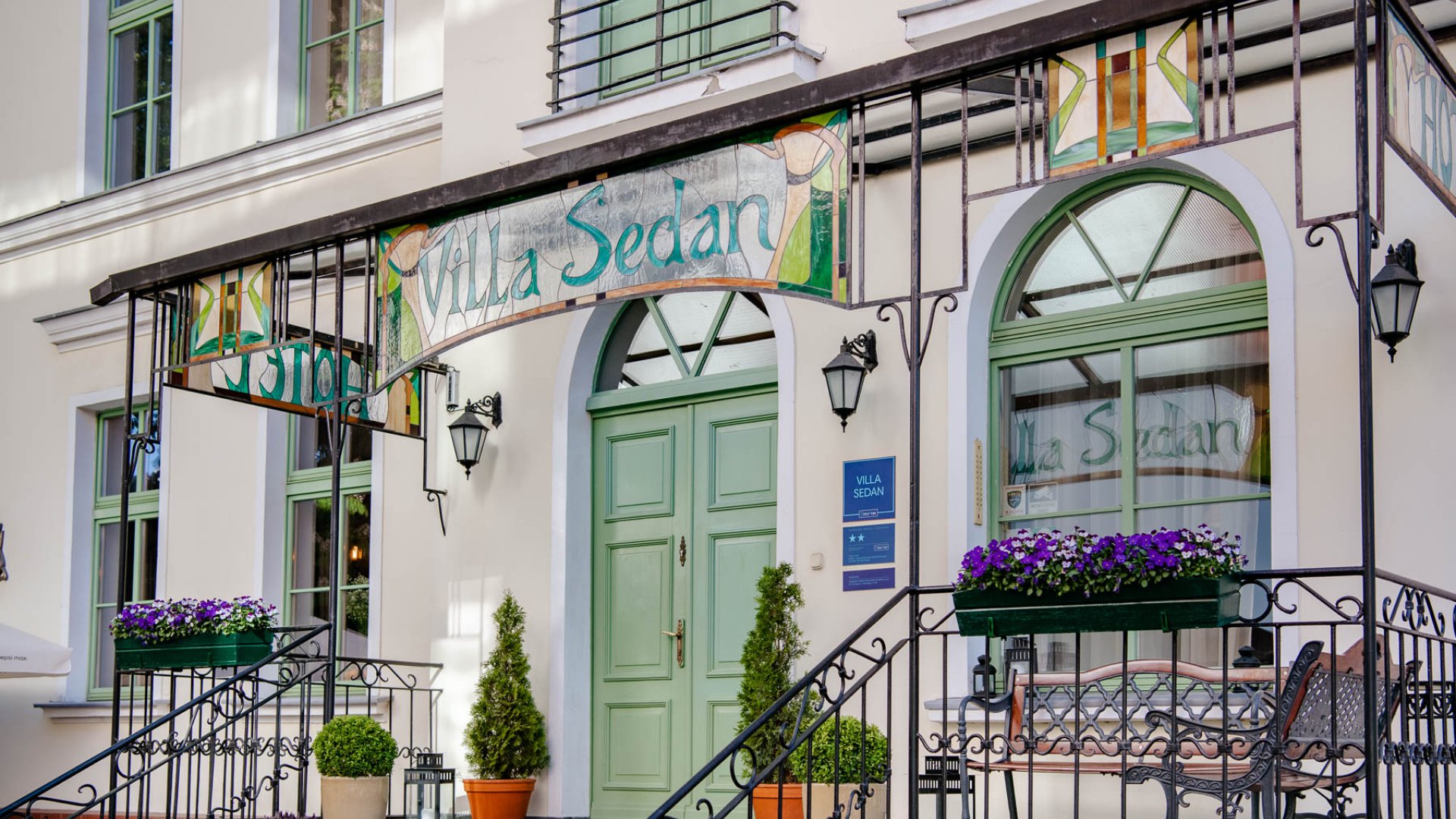
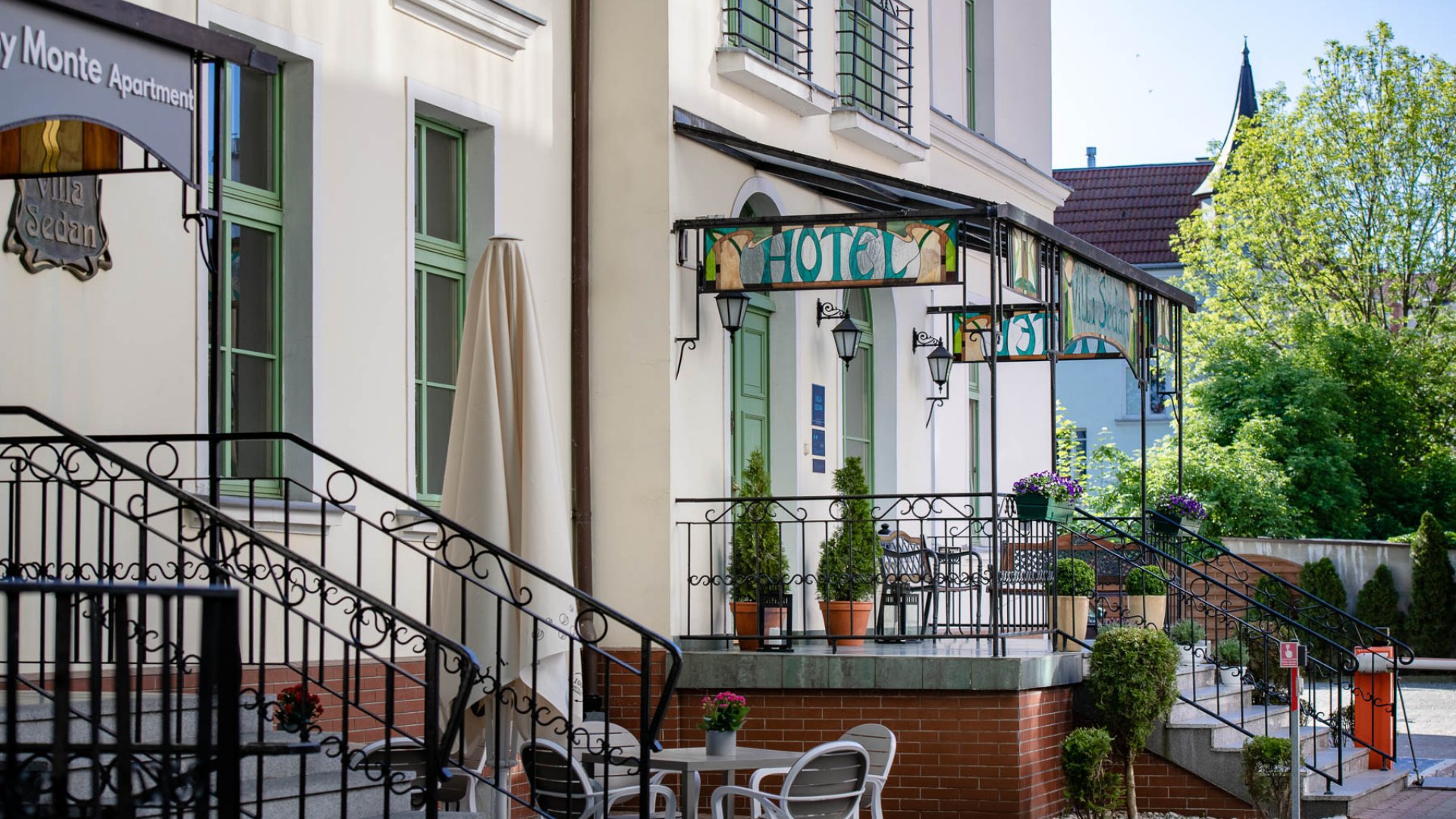
This is the recent history of the Villa Sedan: although there was a huge demand for office space, the owner of the building, Malgorzata Dobrowolska, decided that it would be a waste to turn this beautiful and old house into offices. - "The charm and spirit of the place, so hard to miss here, caused it" -this is how she decided to restore the Villa Sedan to its primary function.

There is no need to talk about pulling down and rearranging the walls, about kilometers of cables and new ceilings. It is only worth mentioning that the cellars were so low that a grown-up person could not walk straight-up. One of the requirements that the owners had to meet in order to welcome the guests anew was to deepen the foundations. A risky and hard work began.

"I served the King of England"

On the 16th of February The villa Sedan was opened. Friends paid their first visit. Bohumil Hrabal was an honour guest. - Hrabal and his novel "I served the King of England" seems to be written just for this occasion and for this place - says Tomasz Arabski, a friend of the house and the Editor-in-chief in Radio Gdansk.

"I served the King of England" is a story of a young waiter from Prague who dreams of building his own hotel.Finally he succeeds, but when the it is completed at the end of the Second World War the communists come to power and take his property over, together with a dreamed of and long awaited new world. Of course, I would not like the similarities to be so huge - Tomasz Arabski laughs - Although we are in Sopot, not in Prague, the atmosphere of the place resembles the atmosphere of Prague between the Two Wars described in the Hrabal's novel. Not only does Hrabal's prose speak about big issues, like Central European cultural unity, but also about little issues, for example that dreams can come true in every latitude, or that everyday life can be a source of true happiness.

Hrabal - according to Tomasz Arabski - is a good omen for the Villa Sedan. Let it be a very good place, where people, both the staff and the guests, like I, have delight in being together.

The same evening two literary traditions, the Prague and the Sopot one, come together. Pawel Huelle, the author of "Mercedes Benz", the novel referring to the Hrabal's prose - says why he loves Bogumil Hrabal, and Krzysztof Gordon, an actor, reads passages from the novel "I served the King of England".


polish version deutsch version russian version


©2005 Villa Sedan.
Design: gd.pl Sp. z o.o.